
I have noticed that a simple Royal Mail dog warning sign can make a surprising difference to whether post arrives safely and on time.
If you have a dog at home, Royal Mail now recommends displaying a clear sign such as “I have a dog” before any delivery takes place.
This small step can help prevent injuries, avoid delivery delays and reduce the risk of your mail service being suspended.
Key points to know:
- Royal Mail recorded 2,197 dog attacks on postal workers in the last year
- A warning sign can help keep deliveries running without interruption
- Failure to secure your dog could lead to suspended mail service
- The sign works best when combined with other safety measures
What Is a Royal Mail Dog Warning Sign and Why Is It Important?
A Royal Mail dog warning sign is a visible notice placed outside your home to warn postal workers that a dog is present. The most common version simply says, “I have a dog”.
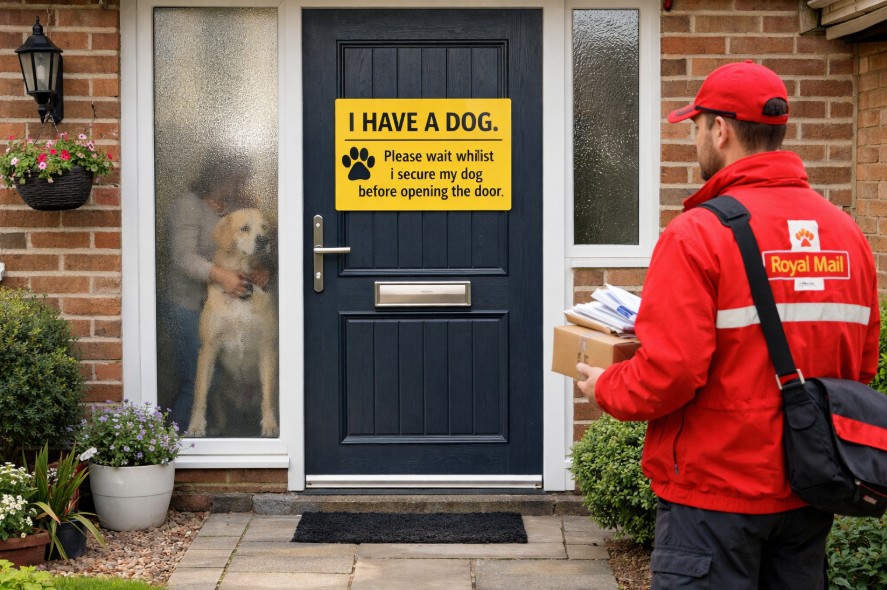
Royal Mail also provides a longer printable sign that reads: “I HAVE A DOG. Please wait whilst I secure my dog before opening the door.”
The purpose of the sign is straightforward. It gives your postie advance warning before approaching your door or gate. Rather than walking straight up to the property, they can pause and allow you time to secure your dog.
This matters because many dog attacks happen in seconds. A dog may react unexpectedly to a stranger, a parcel delivery or the sound of the letterbox. Even dogs that are normally friendly can become territorial when someone approaches the home.
Lizz Lloyd, Health and Safety Director at Royal Mail, explained:
“Dog attacks remain one of the most significant safety risks faced by postal workers. In many cases, these incidents result in serious injuries, emotional distress, and time away from work.”
By displaying a Royal Mail dog warning sign, you create a safer interaction for both your dog and the delivery worker.
What Does the Royal Mail Dog Warning Sign Actually Say?
The wording of the Royal Mail dog warning sign has caused some confusion because two versions are widely used.
The short version is:
“I have a dog”
This is often referred to as the four-word sign and is enough to alert a postie that they should proceed carefully.
The longer official version says:
“I HAVE A DOG. Please wait whilst I secure my dog before opening the door.”
Both versions are acceptable. The shorter sign works well if space is limited, while the longer version provides more detailed instruction. A homemade sign is also acceptable, provided it is easy to read and clearly visible.
Why the Four-Word Sign Works?
The shorter sign is effective because it communicates the message instantly. Postal workers often visit hundreds of properties in a day and need to understand a situation at a glance.
Without any sign, a postie may assume it is safe to approach the door immediately. With a sign in place, they are more likely to stop, stand back and wait.
Is a Homemade Sign Acceptable?
Royal Mail does not require you to use its official printable notice. A simple handwritten or printed sign can work just as well. What matters most is that it is:
- Easy to read
- Positioned where it will be seen
- Visible before the postie reaches the door
Why Is Royal Mail Warning Dog Owners Now?
Royal Mail has renewed its advice because dog attacks on postal workers continue to increase. The latest figures show that 2,197 incidents were reported across the UK in the past year, representing a 2% rise.
That figure means:
| Metric | Number |
| Total dog attacks in one year | 2,197 |
| Weekly average | 42 |
| Approximate daily average | 6 |
| Year-on-year increase | 2% |
These numbers show that attacks are not rare. They happen every week in towns and cities across the UK.
Royal Mail is particularly concerned during busy delivery periods such as Easter, Christmas and bank holidays, when there are more parcel deliveries and therefore more chances for a dog to react unexpectedly.
A Royal Mail spokesperson said:
“Around 2,000 posties like me are injured by dogs each year, both big and small. When this happens, we must inform the police and suspend deliveries to your address.”
The warning is therefore not just about safety. It is also about keeping your post arriving without interruption.
How Can a Royal Mail Dog Warning Sign Affect Your Mail Service?
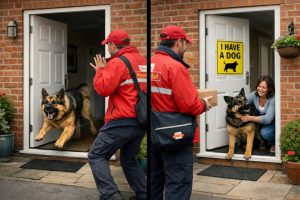
A Royal Mail dog warning sign can directly affect whether your letters and parcels continue to be delivered normally. If there is a dog-related incident at your property, Royal Mail may decide that your address is unsafe.
In practice, this means your mail service could be delayed or suspended until you prove the risk has been removed.
Without a warning sign, the postie may walk directly to your door, increasing the chance of an unexpected encounter. If your dog rushes outside or bites through the letterbox, the delivery worker may report the incident immediately.
What Happens After an Incident?
When an attack or near miss is reported, Royal Mail follows a set process. The incident is reviewed and, in more serious cases, the police may be informed.
| Stage | What Happens | Possible Result |
| Incident reported | Postie logs details of the event | Safety review begins |
| Investigation | Royal Mail assesses the risk | Delivery status considered |
| Police informed | In serious cases only | Legal action possible |
| Delivery suspension | Temporary or permanent | Mail must be collected |
A suspended service does not always mean a permanent stop to deliveries, but it can still be inconvenient. You may need to collect letters and parcels from your local delivery office instead of receiving them at home.
Royal Mail has made its position clear:
“Receiving your letters and parcels is important, but our priority is to get these items to you safely.”
Where Should You Place a Royal Mail Dog Warning Sign?
The sign only works if your postie sees it before approaching the property. That means placement is just as important as the wording itself.
Front Door and Front Gate
The front door is the most effective place because it is usually the first thing a delivery worker sees. If your dog has access to the garden, placing another sign on the front gate can provide an earlier warning.
Near the Letterbox or Window
If your dog becomes excited when mail is posted through the letterbox, it is sensible to place the sign nearby. A sign in a front window can also help if it is clearly visible from the path or driveway.
Royal Mail recommends that the sign should never be hidden behind curtains, decorations or inside the house. It must be seen before the postie reaches the entrance.
What Should You Do Before Opening the Door to a Postie?
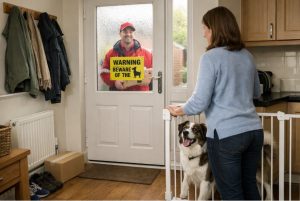
Putting up a sign is only the first step. You must still secure your dog before answering the door.
The safest approach is to place your dog in another room or behind a secure barrier before opening the front door. A few extra seconds can make a huge difference.
For this section, Royal Mail recommends several simple actions:
- Put your dog in another room before answering the door
- Keep side gates closed so the dog cannot run to the front garden
- Ask children not to open the door if the dog is nearby
- Wait until your dog is calm before speaking to the postie
Practical Ways to Keep Your Dog Away from the Door
If your dog regularly becomes excited when the post arrives, you may need to change your routine. Internal baby gates, closed hallway doors and toys can all help reduce the risk.
One Nottingham dog owner, Sarah Mitchell, explained how a warning sign improved the situation at her home:
“I never thought he would actually bite anyone, but he became very protective at the door. Since putting up the sign and keeping him in the kitchen during deliveries, it has made a huge difference.”
Her experience shows that even well-behaved dogs can react differently when a stranger arrives.
Is a Dog Warning Sign Enough on Its Own?
A Royal Mail dog warning sign is helpful, but it is not enough on its own. The sign raises awareness, but it does not physically stop a dog from running outside or attacking through the letterbox.
You should think of the sign as one part of a wider safety plan. The most effective approach combines clear signage with physical measures and consistent routines.
For example, if your dog is likely to bark, jump or run towards the door, you may need to:
- Install a baby gate inside the hallway
- Fit a letterbox cage to prevent bites
- Use a secure outside mailbox
- Keep your dog away from the front entrance during delivery times
A delivery worker summed it up clearly:
“The sign helps, but what matters most is what happens when the door opens. If the dog is not secured, the risk is still there.”
What Other Steps Can Help Prevent Delivery Problems?
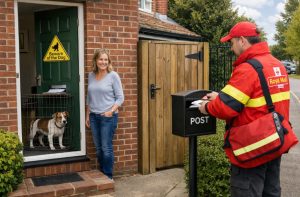
There are several additional measures you can take if your dog regularly reacts to deliveries.
One of the most effective solutions is fitting a wire cage behind the letterbox. This prevents postal workers from being bitten if your dog tries to reach through the flap.
Some households also choose to install an external mailbox at the edge of the property. This means the postie does not need to come close to the front door at all.
Other useful steps include:
- Fitting self-closing gates
- Keeping dogs indoors when expecting a parcel
- Moving dog beds away from the hallway
- Choosing a safe place delivery option for parcels
These small changes can significantly reduce the chance of a future problem.
Which UK Areas Report the Highest Number of Dog Attacks on Postal Workers?
Royal Mail data shows that some parts of the UK experience far more dog attacks than others. Sheffield remains the worst-affected area, followed by Portsmouth and the TN postcode area covering parts of Kent, Sussex and Surrey.
| Rank | Postcode Area | Number of Attacks | Change |
| 1 | S (Sheffield) | 66 | +61% |
| 2 | PO (Portsmouth) | 60 | -3% |
| 3 | TN (Kent, Sussex and Surrey) | 56 | +33% |
| 4 | GU (Guildford) | 54 | +29% |
| 5 | NG (Nottingham) | 49 | +17% |
The figures show that dog attacks are a national issue rather than a problem limited to one region. Urban areas tend to see more incidents because there are more deliveries and more doorstep interactions.
Conclusion
The Royal Mail dog warning sign may seem small, but it can have a significant effect on your mail service.
A clear sign gives your postie time to pause, allows you to secure your dog and helps prevent the kind of incidents that lead to delayed or suspended deliveries.
However, the sign works best when combined with practical safety measures. If you secure your dog, keep gates closed and use visible signage, you can protect both your pet and the people delivering your post.
For many households, four simple words – “I have a dog” – could be the difference between uninterrupted deliveries and a suspended service.
FAQs About the Royal Mail Dog Warning Sign
Can Royal Mail stop delivering to my address because of my dog?
Yes. If your dog is considered a risk to postal workers, Royal Mail may temporarily suspend deliveries until you take steps to make the property safe.
Is the Royal Mail dog warning sign legally required?
No. There is no legal requirement to display the sign, but Royal Mail strongly recommends it as a safety measure.
Can I create my own warning sign?
Yes. You do not need to use the official Royal Mail version. Any clear sign that warns there is a dog at the property is acceptable.
Do small dogs count as a risk?
Yes. Royal Mail says both large and small dogs are involved in attacks on postal workers each year.
Where is the best place to display the sign?
The best location is usually the front door, front gate or beside the letterbox where the postie will see it before approaching.
What happens if a postie is bitten by my dog?
Royal Mail may report the incident, involve the police and suspend deliveries to your address until the situation is resolved.
Will Royal Mail wait while I secure my dog?
Yes. Postal workers are generally happy to wait a few moments while you place your dog in another room or behind a secure barrier.