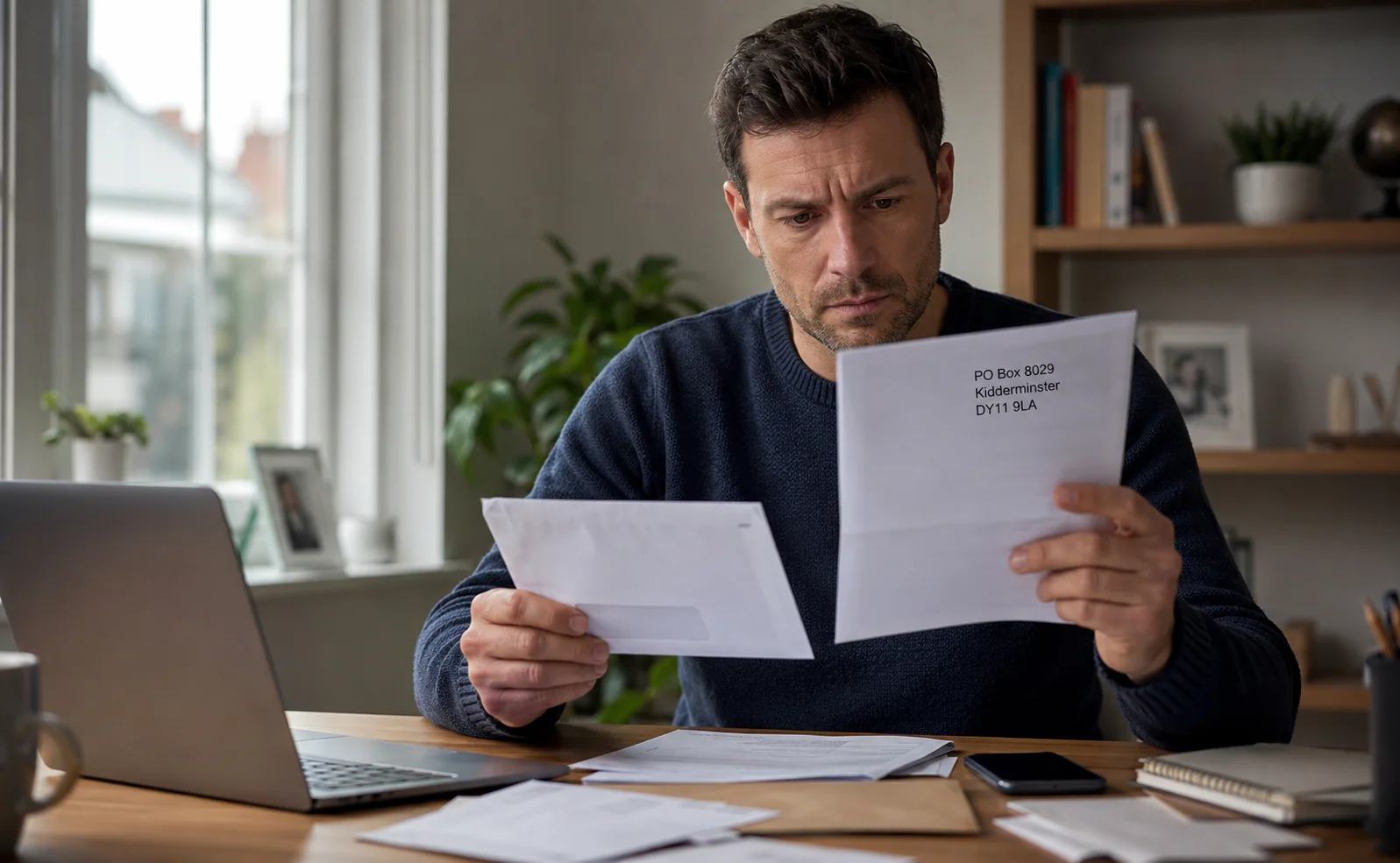

Receiving unexpected mail from PO Box 8029, Kidderminster DY11 9LA may raise questions about whether it is genuine. The address is widely associated with some Lloyds Bank correspondence, including certain Visa debit card mailings, but a return address alone cannot confirm authenticity.
This review found no current official public page listing the exact PO Box as an authenticated correspondence address. Rather than acting immediately, recipients should verify the letter using independently obtained official contact details.
Key highlights:
- Commonly linked to some Lloyds Bank card correspondence.
- A return address alone does not prove a letter is genuine.
- Unexpected bank cards may have legitimate reasons, such as renewal or replacement.
- Be cautious of requests for payments or sensitive information.
- Verify suspicious mail using official contact details.
- A PO Box does not necessarily have a public phone number.
Who Sends Mail from PO Box 8029 Kidderminster DY11 9LA?
The address is commonly associated in public reports with some Lloyds Bank correspondence, particularly mail relating to Visa debit cards. That makes the bank a relevant organisation to check when a recipient receives a PO Box 8029 Kidderminster letter.
However, the wording matters. It would be inaccurate to say that the address itself proves Lloyds Bank sent every item carrying it. A return address identifies where undelivered mail may be directed; it is not a security feature that independently authenticates the contents.
Someone receiving mail from this address should therefore look at the full context. Does the recipient have an account with the named organisation? Is a bank card approaching expiry? Does the correspondence relate to an action the customer recently took? Those questions provide more useful evidence than the postcode alone.
Why Might Someone Receive a PO Box 8029 Kidderminster Letter?
There may be several ordinary explanations for receiving unexpected banking correspondence. A card can sometimes arrive before a customer was consciously expecting it, while account administration may generate letters that do not follow a recent customer request.
Common possibilities include:
- A debit or credit card approaching expiry;
- A replacement for a damaged, lost or previously reported card;
- Routine account or card servicing correspondence;
- Mail sent using older address records;
- Correspondence intended for a previous resident; or
- An item that requires independent verification because the recipient does not recognise it.
An unexpected letter is therefore not automatically evidence of fraud. Equally, recipients should not assume that professional printing, familiar branding or a recognised return address makes every communication genuine.
The right response is to compare the letter with the recipient’s real circumstances before following any instructions.
Is PO Box 8029 Kidderminster DY11 9LA Really Linked to Lloyds Bank?

Publicly available evidence links PO Box 8029, Kidderminster DY11 9LA with some Lloyds Bank card correspondence, including Visa debit mailings.
However, this does not mean every letter using the address is automatically genuine, as no current official public directory confirms it as an authenticated correspondence address.
A return address is only one indicator of legitimacy. Recipients should also consider whether the letter was expected, relates to an existing account and can be verified through official Lloyds Bank contact details.
Confusion may arise if the recipient does not bank with Lloyds, receives an unexpected card or notices incorrect details. In such cases, the safest approach is to verify the communication independently before taking any action.
How Can a Recipient Check Whether Mail from PO Box 8029 Kidderminster Is Genuine?
The most reliable approach is to verify the communication separately from the letter itself. A recipient should avoid treating a telephone number, QR code, email address or web address printed in unexpected correspondence as automatically trustworthy.
Verification checklist:
| Check | What to look for | Safer response |
| Recipient details | Correct name and relevant account context | Investigate unexplained errors |
| Reason for contact | Matches known account activity | Question unexpected requests |
| Payment request | Routine and independently confirmed | Pause any urgent transfer |
| Contact details | Can be independently verified | Avoid relying only on the letter |
| Account activity | Matches trusted banking records | Contact the organisation if it does not |
Where the letter appears to concern Lloyds Bank, recipients can compare the situation with official scam call guidance and use a trusted contact route obtained independently.
The bank’s published guidance makes one particularly clear statement:
“We’ll never call to tell you to move money to another account.”
Verification should be completed before money is transferred or sensitive information is disclosed.
Is There a PO Box 8029 Kidderminster DY11 9LA Phone Number?
People searching for a PO Box 8029 Kidderminster DY11 9LA phone number should not assume that the PO Box has its own dedicated public telephone line.
A PO Box is a postal address, and the appropriate contact number depends on the organisation responsible for the particular correspondence. Where a letter appears to come from a bank, the safest practice is to obtain contact details independently rather than simply calling an unfamiliar number printed in an unexpected letter.
A trusted route could include an existing banking app, the organisation’s official contact page or a number already known to the customer. For suspicious bank-related calls, UK banking guidance also refers customers to 159 as a route for contacting participating banks securely.
Caller ID should not be treated as proof on its own, because official guidance warns that fraudsters can imitate displayed telephone numbers.
What Warning Signs Could Suggest That a Letter Needs Further Investigation?

A suspicious letter is usually better assessed by its behaviour and demands than by its design. Pressure, secrecy and unusual requests are stronger warning signals than minor formatting differences.
Urgent Payments and Sensitive Information
Be especially cautious if a letter creates a sense of urgency or asks for sensitive financial or personal information. These requests are common warning signs of potential fraud and should always be verified independently before any action is taken.
Recipients should take additional care where a letter:
- Demands an immediate bank transfer;
- Instructs someone to move money to a “safe account”;
- Asks for passwords, PINs or one-time security codes;
- Requests unexpected fees before releasing money; or
- Discourages the recipient from independently checking the request.
Official fraud guidance also identifies urgent payment requests and attempts to obtain personal details as warning signs.
Unexpected Tax Refunds and Official-sounding Threats
A letter mentioning HMRC, a tax refund or a penalty should be checked on its own merits. The Kidderminster PO Box should not be treated as evidence of an HMRC connection.
HMRC maintains official letter checking guidance covering recent correspondence. That page was last updated on 6 July 2026. A familiar organisation name, postcode or official-looking layout should therefore support further checking, not replace it.
What Should Someone Do If an Unexpected Lloyds Bank Card or Letter Arrives?
Receiving an unexpected Lloyds Bank card or letter does not automatically indicate fraud. Before taking any action, check whether there is a genuine reason for the communication and avoid making assumptions based on the envelope alone.
Steps to Take:
- Check your account: Confirm whether the card is a renewal or replacement.
- Review recent activity: Look for any requests or changes that may explain the mailing.
- Contact the bank directly: Use official contact details obtained independently.
- Avoid sharing information: Never disclose passwords, PINs or security codes.
- Do not activate the card: Wait until its legitimacy has been confirmed.
- Handle misaddressed mail carefully: If it is for someone else, do not treat it as your own.
The safest approach is to verify both the account and the communication independently before using the card or responding to the letter.
How Should UK Recipients and Businesses Respond Before Taking Action?

Individuals and businesses both benefit from a simple pause-and-check process. Postal fraud can exploit the same human reactions as email or telephone scams: urgency, authority and fear of financial consequences.
For individual recipients:
- Check whether the communication matches a real account or recent event.
- Avoid making urgent payments while doubts remain.
- Use independently obtained contact details.
- Keep suspicious correspondence where it may be needed as evidence.
For businesses:
- Require independent checks before changing payment instructions.
- Separate receipt of a payment request from final approval.
- Train staff to recognise suspicious postal as well as digital communications.
- Record unusual requests and preserve relevant correspondence.
A business should not allow the appearance of an official letter to override its normal payment controls. The more urgent or unusual the request, the more important independent verification becomes.
What Should Someone Do If They Have Already Responded to a Suspicious Letter?
If you have already responded to a suspicious letter, act as soon as possible but avoid panicking. Prompt action can help limit financial loss, protect your personal information and improve the chances of resolving the issue quickly with the relevant organisation.
Contact the Relevant Organisation Immediately
If you believe your financial information or money may be at risk:
- Contact your bank immediately using official contact details obtained independently rather than those provided in the letter.
- Explain exactly what happened, including any information you shared or payments you made.
- Follow the bank’s fraud-prevention advice and notify the organisation the letter claimed to represent if appropriate.
Secure Potentially Affected Accounts
Review all potentially affected accounts without delay and strengthen their security. Change any compromised passwords, PINs or online banking credentials where necessary, enable additional security features if available, and carefully check recent transactions for payments or activity you do not recognise.
Report any suspicious transactions to your bank immediately so they can investigate and take appropriate action.
Report Suspected Fraud and Keep Evidence
Keeping accurate records can make it easier for your bank or the relevant authorities to investigate. Where possible, retain:
- The original letter and envelope for reference.
- Phone numbers, website addresses and payment details mentioned in the communication.
- Copies of emails, messages or notes from any conversations related to the incident.
If you suspect fraud, report it through the official UK fraud-reporting service and continue following your bank’s guidance throughout the investigation.
Acting quickly and keeping clear evidence gives your bank or the relevant organisation the best opportunity to secure your accounts, investigate the incident and recommend the most appropriate next steps.
Conclusion
Receiving mail from PO Box 8029 Kidderminster DY11 9LA does not automatically mean there is a problem, but the return address alone should not be treated as proof that a letter is genuine.
The address is commonly reported in connection with some Lloyds Bank correspondence, yet unexpected requests should always be checked independently.
Recipients should pause before sharing sensitive information or sending money, use trusted official contact channels, and keep suspicious correspondence if further investigation or reporting becomes necessary later.
Frequently Asked Questions
Can a genuine bank use a PO Box as a return address?
Yes. Large organisations may use centralised postal handling and PO Box addresses for correspondence. However, a genuine return address should not be treated as proof that every letter displaying it is authentic.
Why might a replacement bank card arrive before the current one expires?
Banks may issue replacement cards in advance of expiry or because of account or card servicing requirements. Where the timing is unexpected, the customer should check the reason through a trusted account or contact route.
Can scammers copy a genuine return address onto a fake letter?
A familiar address, logo or organisation name is not conclusive proof of authenticity. The safest assessment considers the request being made and whether the communication can be independently verified.
Should a recipient use a website address printed in an unexpected letter?
Where correspondence is unexpected or suspicious, it is safer to find the organisation’s official website independently rather than relying only on a printed link or QR code.
What should happen to financial mail addressed to a previous resident?
Mail addressed to another person should not be treated as the current resident’s own correspondence. Appropriate return-to-sender procedures can be used, particularly where the named person no longer lives at the address.
Does an unexpected tax refund letter mean money is definitely owed?
No. An unexpected refund claim should be checked independently with the relevant authority. Requests for fees, sensitive information or urgent action require particular caution.
Should suspicious letters and envelopes be kept?
Yes. Where fraud or impersonation is suspected, the original correspondence may contain useful information such as return details, contact numbers, postmarks and payment instructions.
Editorial Note:
The wording in this article deliberately distinguishes between a reported association and an independently authenticated sender.
The available public evidence indicates that PO Box 8029 Kidderminster DY11 9LA has appeared on some Lloyds Bank Visa debit correspondence. However, this review did not identify a current public official directory page explicitly confirming that every item carrying the address originates from Lloyds Bank.
For that reason, the address should not be used by itself to declare a letter genuine or fraudulent. The content, account context and independent verification process remain essential.
How We Checked?
This review examined the address and postcode, publicly available references, official banking fraud guidance, government advice on checking tax-related letters and the UK’s fraud-reporting guidance.
Priority was given to official sources, while secondary material was used only for context and not as proof of ownership. No current official page confirming PO Box 8029, Kidderminster DY11 9LA as an authenticated correspondence address was identified, so no ownership claim has been made.
As fraud guidance and contact details can change, readers should always verify the latest information through official channels before taking action.