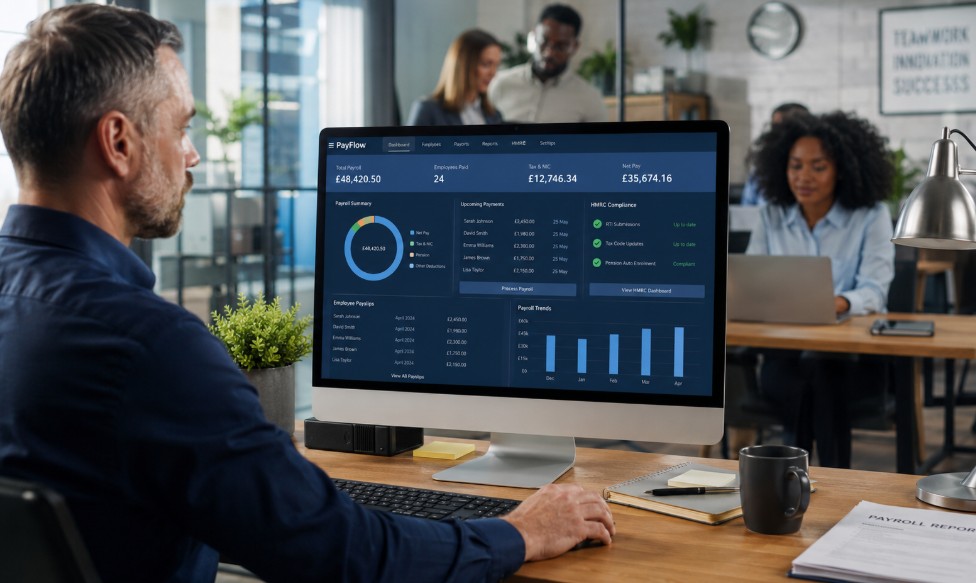

Managing payroll can be challenging for UK small businesses, especially with PAYE calculations, pension auto-enrolment, and HMRC RTI submissions. The best payroll software for small business helps automate these tasks, reduce errors, and improve compliance.
Modern payroll systems also integrate with accounting and HR tools, making payroll management faster and more efficient for startups, SMEs, and micro-businesses.
This article covers:
- Why payroll software matters for UK businesses
- Key payroll features to consider
- HMRC-recognised payroll software benefits
- The top payroll software options in the UK
- Pricing and integration comparisons
By the end, you will know which payroll software best fits your business needs.
What Is Payroll Software and How Does It Work?

Payroll software is a digital tool that automates employee payments, tax deductions, pension contributions, and HMRC reporting. Instead of relying on spreadsheets, businesses can manage payroll more efficiently through cloud-based or desktop systems.
Key functions of payroll software include:
- Automatic salary and wage calculations
- PAYE and National Insurance deductions
- Pension auto-enrolment management
- Employee payslip generation
- HMRC RTI submissions
- Holiday and leave tracking
- Integration with accounting software
Many payroll solutions also include employee self-service portals, allowing staff to access payslips, update personal information, and manage leave requests online.
Comparison of Payroll Software Types:
| Type | Best For | Main Benefit |
| Cloud-Based Payroll | SMEs and startups | Remote access and automation |
| Desktop Payroll | Traditional businesses | Offline functionality |
| HR & Payroll Platforms | Growing companies | Combined HR and payroll tools |
| Free Payroll Software | Micro businesses | Lower cost |
Payroll software continues to evolve as automation and cloud technology become more important for modern businesses. Choosing the right platform can save considerable time and improve payroll accuracy.
Why Is Payroll Software Important for Small Businesses in the UK?
Payroll software helps small businesses improve efficiency, reduce errors, and remain compliant with UK payroll regulations.
Manual payroll processing often leads to mistakes, delayed submissions, and unnecessary administrative work. By automating payroll tasks, businesses can save time and focus on growth.
Main benefits include:
- Faster payroll processing
- Improved HMRC compliance
- Reduced payroll errors
- Easier pension management
- Better employee experience
Cloud payroll software is also useful for remote and hybrid working because payroll data can be securely accessed online.
“Digital payroll systems help businesses improve reporting accuracy and remain compliant with changing tax regulations,” says an HMRC payroll compliance advisor.
As businesses grow, payroll complexity increases. Automated systems make managing larger teams much easier.
“Payroll automation is no longer just a convenience for SMEs — it has become an operational necessity,” explains a UK payroll software consultant.
Overall, payroll software simplifies payroll management while helping businesses stay compliant.
What Should You Look for in UK Payroll Software?
Choosing payroll software involves more than comparing prices. Businesses should focus on compliance, automation, integrations, and scalability.
HMRC Recognition and RTI Submissions
HMRC-recognised payroll software supports compliant RTI submissions and reduces the risk of filing errors or penalties. Reliable platforms also provide automatic updates when payroll regulations change.
PAYE, National Insurance and Pension Auto-Enrolment
The best payroll software for small business should automate PAYE calculations, National Insurance deductions, and workplace pension contributions.
Auto-enrolment pension support is especially important because UK employers must comply with workplace pension regulations. Good payroll software automatically calculates contributions and integrates with pension providers.
Some payroll systems also support statutory payments such as:
- Statutory Sick Pay (SSP)
- Statutory Maternity Pay (SMP)
- Statutory Paternity Pay (SPP)
These automated features reduce manual administration while improving payroll accuracy.
Pricing, Integrations and Employee Self-Service
Pricing structures vary widely across payroll software providers. Some platforms charge monthly subscription fees, while others use per-employee pricing models.
Businesses should also consider software integrations carefully. Many payroll systems connect with:
- Xero
- QuickBooks
- Sage
- HR management systems
- Time tracking tools
Employee self-service portals are another valuable feature. These portals allow staff to access payslips, update information, and manage leave requests independently, reducing HR workload.
The ideal payroll software should balance affordability, automation, compliance, and ease of use.
How Does HMRC-Recognised Payroll Software Help Your Business?

HMRC-recognised payroll software helps businesses stay compliant with UK payroll regulations while simplifying reporting tasks. These systems automatically update in line with changing tax requirements.
One major advantage is automated RTI submissions, which reduce administrative work and minimise filing errors.
Benefits of HMRC-recognised payroll software include:
- Faster payroll processing
- Improved compliance
- Automatic tax updates
- Secure payroll records
- Easier year-end reporting
Many systems also include employee portals and reporting dashboards that improve payroll visibility.
Using recognised payroll software helps businesses reduce compliance risks while improving payroll accuracy.
How Can the Right Payroll Software Save Time and Reduce Errors?
The right payroll software helps small businesses save time by automating repetitive payroll tasks and reducing the risk of manual errors, incorrect payments, tax issues, or compliance problems.
Key Tasks Payroll Software Can Automate:
- Payslip generation for employees with accurate salary, deduction, and payment details
- Tax calculations based on current payroll rules and employee earnings
- Pension deductions and contribution records for workplace pension compliance
- Payroll reporting to support accounting, audits, and financial planning
- Employee onboarding by storing payroll details, tax codes, and payment information
- Secure online payslip access so employees can view records without asking managers
Cloud payroll software also supports remote payroll management and gives businesses better visibility over payroll costs.
By improving accuracy, productivity, and compliance, it reduces administrative pressure and helps small businesses focus more on growth.
10 Best Payroll Software for Small Business in the UK (2026)
| • Calculates tax, NI and student loans automatically | • Files Full Payment Submissions (FPS) direct to HMRC |
| • Workplace pension auto-enrolment and provider links | • Employee self-service portal for payslips and P60s |
| • Automated recurring pay runs for salaried employees | • Employer Payment Summaries (EPS) submitted automatically |
|
PROS
• Seamless HMRC and pension integration out of the box
• Auto-enrolment reduces manual admin tasks drastically
• Scalable tiers from solo directors to growing teams
• Tight integration with QuickBooks Online accounting
|
CONS
• Payroll is a paid add-on, increasing your monthly bill
• Pension staging setup can be complex for beginners
• Per-employee fees add up for larger teams
• Xero may offer simpler base pricing at lower employee counts
|
|
Standard Payroll
Essential PAYE & payslips
£4/mo base
+ £1–£1.30 per paid employee/month
PAYE · PAYSLIPS · HMRC SUBMISSIONS
|
★ MOST POPULAR
Advanced Payroll
Auto runs + HR features
£8–£10/mo base
+ £2–£3 per paid employee/month
AUTO RUNS · HR TOOLS · EMPLOYEE PORTAL
|
| • Calculates PAYE, NI, student loans and statutory payments | • Submits RTI directly to HMRC in real time |
| • Generates and issues digital payslips and P60s | • Automatic workplace pension assessment and contributions |
| • Self-assessment integration for sole traders and directors | • Making Tax Digital (MTD) compliance built in |
|
PROS
• No extra per-employee payroll charges
• Completely free with NatWest, RBS, or Mettle account
• Integrated RTI and MTD compliance
• Jargon-free, highly intuitive interface
|
CONS
• Designed for small teams — not large corporations
• Mobile app lacks full payroll processing capability
• £29/month limited company plan is pricey without bank perk
• Lacks advanced HR scheduling for larger teams
|
|
Sole Trader
Freelancers & self-employed
£19/mo + VAT
or £190/yr + VAT
50% OFF FIRST 6 MONTHS
|
Partnership / LLP
Partnerships & LLPs
£24/mo + VAT
or £240/yr + VAT
50% OFF FIRST 6 MONTHS
|
★ MOST POPULAR
Limited Company
Directors & ltd companies
£29/mo + VAT
or £290/yr + VAT
FREE WITH NATWEST / METTLE
|
| • Calculates PAYE, NI and statutory payments automatically | • Submits RTI directly to HMRC after every pay run |
| • Four-step payroll process for salaries, overtime and bonuses | • Pension auto-enrolment, opt-out and provider links |
| • Employee self-service app for payslips and time-off requests | • Integrates with Sage Accounting and Sage HR |
|
PROS
• Very accessible for non-accountants with onboarding wizard
• Consistently updated for UK tax thresholds and GDPR
• Seamless integration with Sage Accounting and Sage HR
• Deep UK legacy — trusted by thousands of businesses
|
CONS
• Excel export formatting can feel clunky for some users
• Basic plans may lack scheduling for larger enterprises
• Mixed customer support experiences at year-end peaks
• UI feels less modern than newer cloud-native competitors
|
|
Small Business
Up to 10 employees
From £20/mo
Scales to ~£150/mo for larger teams
PAYE · RTI · PENSIONS · HR TOOLS
|
★ MOST POPULAR
Payroll Add-on
Existing Sage Accounting users
From £5/mo
£5–£7/month as a module add-on
BEST VALUE FOR SAGE USERS
|
Sage 50 Enterprise
Complex large payrolls
Custom pricing
Tailored quote on request
ADVANCED PAYROLL & COMPLIANCE
|
| • Direct API integration with HMRC for RTI submissions | • Links with Nest, Smart Pension and The People’s Pension |
| • Auto-enrolment, furlough calculations and benefits payrolling | • BrightPay Connect: cloud backups and employee self-service |
| • Syncs with Xero, FreeAgent, QuickBooks and ClearBooks | • Bureau dashboard for managing multiple client payrolls |
|
PROS
• Handles complex payrolls and auto-enrolment effortlessly
• Excellent UK-based, highly responsive customer support
• Easy mistake correction and period reopening
• Outstanding value for accountancy bureaus
|
CONS
• Cloud features (employee portals) require BrightPay Connect add-on
• Desktop-to-cloud transition has increased costs for some users
• Pricing model can be less predictable with the Connect add-on
• Desktop software is evolving — full cloud migration underway
|
|
Up to 3 Employees
Micro businesses
£79+ VAT/yr
Per tax year
DESKTOP LICENCE
|
Up to 10 Employees
Small businesses
£139+ VAT/yr
Per tax year
DESKTOP LICENCE
|
★ MOST POPULAR
Up to 25 Employees
Growing teams
£209+ VAT/yr
Per tax year
DESKTOP LICENCE
|
Unlimited Employees
Bureaus & large teams
£289+ VAT/yr
Per tax year
DESKTOP LICENCE
|
| • Real-time HR sync — new hires and changes update payroll instantly | • UK-specific NI, student loan and pro-rata salary calculations |
| • National Minimum Wage compliance alerts built in | • Employee self-service payslips and parental pay breakdowns |
| • Deep workforce planning, budgets and what-if scenarios | • Year-end processing and audit trails streamlined |
|
PROS
• Eliminates double data entry between HR and payroll
• Visually appealing, highly intuitive interface
• Highly customisable for specific org structures
• Strong analytics on pay equity and headcount planning
|
CONS
• No transparent pricing — requires custom sales quote
• Setup and configuration can be time-consuming
• Advanced modules significantly increase per-employee cost
• Implementation fee typically 10–20% of annual software cost
|
|
Base HRIS Platform
Core HR features
$8–$25/emp/mo
Industry estimate — varies by features
CORE HR + ONBOARDING
|
★ KEY MODULE
UK Payroll Module
Native UK payroll add-on
Custom quote
Priced separately from base platform
PAYE · RTI · NI · REAL-TIME SYNC
|
Implementation
One-time setup fee
10–20% of annual
Of total annual software fees
ONE-TIME SETUP COST
|
| • PAYE, NI, student loans and pension assessments automated | • RTI submissions filed directly to HMRC automatically |
| • HR and rota integration syncs absences and shifts to payroll | • CIS contractor management and off-payroll reporting |
| • On-demand instant payslip generator for one-off runs | • Cloud-based dashboard with minimal learning curve |
|
PROS
• Pay-per-user model — only pay for what you need
• First employee is always free — ideal for startups
• HR, rotas and payroll sync seamlessly to reduce errors
• Intuitive dashboard with very little learning curve
|
CONS
• Fewer integrations than larger legacy payroll providers
• High staff volumes can become costlier than flat-rate packages
• Less suited for complex enterprise or ERP environments
• Limited advanced analytics compared to HRIS platforms
|
|
Sole Trader / Director
Single-person companies
£0/mo
Completely free to use
ALWAYS FREE
|
★ MOST POPULAR
Standard Business
Growing teams
From £2.50/emp/mo
First employee always free
RATES REDUCE AT VOLUME
|
Instant Payslip
One-off ad-hoc runs
£3.99/payslip
No subscription required
PAY PER PAYSLIP
|
| • Time-and-attendance connects directly to payroll runs | • Automated PAYE, NI and RTI submissions to HMRC |
| • HR data syncs in real time — no double entry for leave or salaries | • Employee mobile app for payslips, leave and timesheets |
| • Onboarding, performance management and payroll in one dashboard | • Benefits management and HR advisory tools available |
|
PROS
• Seamless HR and payroll synchronisation saves admin time
• Clean, modern interface easy for managers and staff
• All-in-one: onboarding, benefits, performance and payroll
• Excellent mobile app drives strong team engagement
|
CONS
• Complex break times or contract types can be slow to configure
• Advanced payroll requires upgrading from the free tier
• Some integrations locked behind higher-tier plans
• Overly complex for businesses needing standalone payroll only
|
|
Free Payroll
Very small businesses
£0/mo
Baseline payroll processing
PAYE · RTI · BASIC PAYSLIPS
|
★ MOST POPULAR
Standard HR Plans
HR + payroll combined
£4–£5.50/emp/mo
Min. £30/month account fee
HR + PAYROLL + ONBOARDING
|
Advanced / Managed
Bureau & full-service payroll
Custom quote
Requires demo to confirm
MANAGED PAYROLL + HR ADVISORY
|
| • Payroll linked with time, attendance and absence management | • Employee self-service portal for payslips, holidays and details |
| • Auto-enrolment, PAYE, NI calculated and filed automatically | • Real-time reporting and customisable payroll cost dashboards |
| • Auto-updates with every new UK tax year rule change | • CIPP-certified expert support available when you need it |
|
PROS
• UK-based CIPP-certified support team — highly responsive
• HR, time & attendance and payroll in one platform
• Rolling monthly contracts — no long-term commitments
• Auto-updates aligned to UK tax year legislation
|
CONS
• Minor bugs reported with mobile app and timeclock entry
• Base monthly fee may be high for very small micro-teams
• Less well-known than larger SaaS payroll platforms
• Simpler micro-employer tools (e.g. HMRC Basic) cost nothing
|
|
Weekly Payroll
Weekly pay runs
£15/week base
+ £1.32 per employee per week
ROLLING MONTHLY · NO LOCK-IN
|
★ MOST POPULAR
Monthly Payroll
Standard monthly pay runs
£53/mo base
+ £3.20 per employee per month
ROLLING MONTHLY · NO LOCK-IN
|
| • 100% automated pension assessment and communication | • FPS and EPS submitted directly to HMRC |
| • Employee self-service portal for payslips, P60s and HR docs | • Direct Xero integration and Modulr automated payments |
| • Bureau dashboard: manage multiple employers and payrolls | • Client report automation for accountancy bureaus |
|
PROS
• Exceptional value for SMEs managing multiple companies
• Seamless pension sync takes manual labour out of auto-enrolment
• Highly scalable for large payrolls and agency requirements
• Direct Xero integration suits existing Xero accounting users
|
CONS
• Per-payslip add-on model less predictable for large groups
• Initial learning curve steeper than some slicker alternatives
• Free tier lacks automated email and bulk bank transfers
• Less known in the market than Sage, Xero or QuickBooks
|
|
Standard
Up to 99 employers
£21/mo
25 employees per employer
AUTO-ENROLMENT · EMAIL SUPPORT
|
★ MOST POPULAR
Professional
Up to 250 employers
£35/mo
Unlimited employees
UNLIMITED EMPLOYEES
|
Enterprise
Unlimited employers
£45/mo
+ £0.40 per payslip/month
PRIORITY PHONE · REPORT AUTOMATION
|
Payroll Software Comparison Table for UK Small Businesses
Choosing the right payroll software helps UK small businesses manage payslips, HMRC RTI submissions, pensions, tax, and employee records more easily. Here is a simple comparison of the best payroll software options for small businesses in the UK.
Conclusion
Choosing the best payroll software for small business in the UK depends on company size, budget, compliance needs, and growth plans. Options like Xero, QuickBooks, BrightPay, and Sage support different business requirements.
Modern payroll software automates tax calculations, pension management, compliance, and salary processing.
Whether you need free tools or advanced HR features, HMRC-recognised payroll software can improve accuracy, efficiency, and employee satisfaction in 2026.
FAQs About Best Payroll Software for Small Business
What is the best payroll software for small businesses in the UK?
The best payroll software depends on your business needs. Xero, QuickBooks, BrightPay, and Sage are among the most popular choices for UK SMEs.
Does payroll software need HMRC recognition?
Yes, HMRC-recognised payroll software ensures compliance with UK payroll reporting requirements and supports RTI submissions.
What is the best free payroll software in the UK?
HMRC Basic PAYE Tools and Employment Hero offer free payroll software options suitable for small businesses.
Can payroll software automate PAYE and RTI submissions?
Most modern payroll systems automatically calculate PAYE deductions and submit RTI reports directly to HMRC.
Which payroll software is easiest for beginners?
QuickBooks Payroll and Xero Payroll are widely regarded as beginner-friendly platforms with intuitive dashboards and setup processes.
How much does payroll software cost for small businesses?
Payroll software pricing varies from free tools to subscription-based platforms costing between £10 and £100+ per month depending on features and employee count.
Can payroll software integrate with accounting software?
Yes, many payroll platforms integrate with accounting systems such as Xero, QuickBooks, and Sage to simplify financial management.