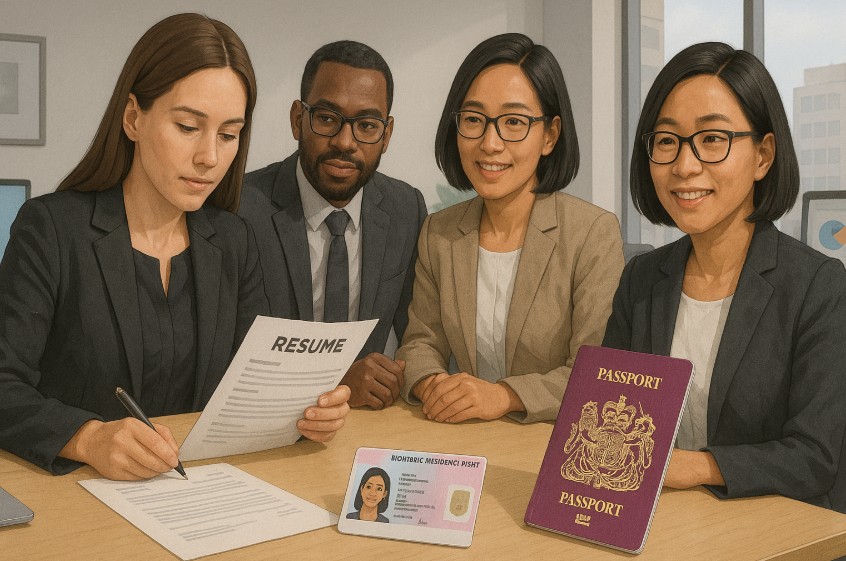

In today’s immigration-regulated employment landscape, right to work checks are a legal cornerstone for UK employers. These checks help businesses confirm whether a prospective employee is legally allowed to undertake the work in question.
Beyond a basic document review, right to work checks form a critical line of defence against illegal working and the severe civil and criminal penalties that may follow non-compliance.
This guide offers a complete overview of what right to work checks entail, who must be checked, how employers should carry them out, and the consequences of failing to meet Home Office requirements.
Whether you’re an SME or a large enterprise, understanding your legal obligations in this area is essential to remain compliant and protect your business from legal risks.
What Are Right to Work Checks and Why Are They Mandatory in the UK?

Right to work checks are a legal obligation for employers under the Immigration, Asylum and Nationality Act 2006. They ensure that individuals hired for employment in the UK are legally allowed to work here.
The checks serve both as a safeguard for lawful employment and as a statutory excuse for employers should an issue arise.
Failure to conduct a right to work check, or doing so incorrectly, may result in civil penalties of up to £60,000 per illegal worker or even criminal prosecution. Therefore, employers must take these checks seriously and follow the official Home Office guidance precisely.
Who Needs to Undergo a Right to Work Check in the UK?
All employees, regardless of their nationality, background, or job type, must undergo a right to work check before starting employment.
Making assumptions based on someone’s accent, skin colour, or country of origin is not only discriminatory but also against the law.
This includes:
- UK citizens
- EU, EEA, and Swiss nationals
- Visa holders under the points-based system
- International students
- Refugees and asylum seekers
- Temporary, seasonal, or agency staff
Employers must conduct the check for every new hire, even if the individual has worked in the UK before or claims they’ve already proven their right to work at a previous job. Each employment is considered a new case.
For employees with time-limited permission to work, employers must also perform follow-up checks before their existing documents expire.
How Should Employers Conduct a Manual Right to Work Check?

Manual right to work checks involve physically inspecting the individual’s original documents and verifying their authenticity in person. This method remains vital for those who cannot use digital or online services.
Step 1: Obtain Original Documents
Ask the individual to provide one or more documents from the Home Office’s List A or List B. These may include a valid passport, biometric residence permit, or a combination of acceptable documents.
Only original documents are valid, photocopies or digital scans cannot be used for manual checks.
Step 2: Check Documents in the Presence of the Individual
Verify the documents are genuine, belong to the applicant, and that they are authorised to do the work being offered. Look for:
- Consistent names and dates
- Unexpired permission to work
- Matching photographs
- No signs of tampering
Step 3: Copy and Record
Once verified, take a clear copy of the document(s), including all pages with relevant information. Then record the date the check was completed and write the following statement on the copy:
I [Your Full Name] have undertaken a right to work check on [Date].
These records must be stored securely for the duration of employment and two years after it ends.
What Is the Digital Right to Work Check and Who Can Use It?
The digital right to work check is available to British and Irish citizens with valid passports. Employers can verify identity using a certified Identity Service Provider (IDSP) that uses Identity Document Validation Technology (IDVT).
Benefits of Digital Checks
- Time-efficient and accessible remotely
- Reduces errors in verification
- Secure and compliant with Home Office regulations
Employer Responsibilities
While IDSPs handle the document validation, employers must still:
- Confirm the image provided matches the person
- Retain a copy of the check output
- Ensure internal staff are trained to interpret IDSP reports
Even when using an IDSP, employers are still responsible for confirming that the image matches the person presenting for work and for securely storing the identity check result.
How Does the Home Office Online Right to Work Service Work?
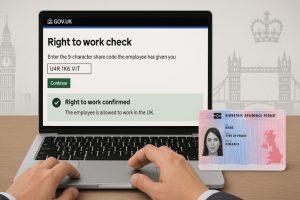
The Home Office online service is the recommended method for checking the right to work of non-British and non-Irish nationals. It uses an individual’s eVisa, a digital record of their immigration status.
To begin, the candidate generates a share code on the GOV.UK website under the “prove my right to work” option. The employer then enters this code along with the person’s date of birth into the online service. The system displays the individual’s work status, any restrictions, and their photograph.
Employers must ensure the photo matches the individual, download or screenshot the check result, and retain it for the duration of employment plus two years. It’s important to note that share codes for right to/ work checks differ from those used for identity verification.
What Happens if Employers Fail to Complete Right to Work Checks Correctly?

The risks of non-compliance are substantial, and growing. Employers can face the following consequences:
- Civil penalties: Up to £60,000 per illegal worker
- Criminal liability: Including imprisonment for up to 5 years
- Loss of ability to sponsor overseas workers
- Closure notices from immigration officers
- Confiscation of earnings under the Proceeds of Crime Act
- Reputational damage affecting future recruitment
Even if a worker is found to be working illegally, if the employer can demonstrate that a valid check was completed in line with Home Office guidance, they can rely on a statutory excuse to avoid penalties.
When Should Employers Carry Out Repeat or Follow-Up Right to Work Checks?
Repeat checks are essential when an employee has a time-limited right to work. The timing and type of follow-up check depend on whether the original document was from List B Group 1 or Group 2.
Table: Frequency of Right to Work Checks
| Document Type | Statutory Excuse Type | Frequency of Check |
| List A | Continuous | Initial check only |
| List B – Group 1 | Time-limited | Initial check + when permission expires |
| List B – Group 2 | Time-limited | Initial check + every 6 months |
Employers should maintain a robust tracking system for visa expiry dates and schedule follow-up checks well in advance to remain compliant.
If an employee applies to extend their visa before expiry, the employer can obtain a Positive Verification Notice (PVN) from the Home Office, which grants a statutory excuse for an additional six months while the application is processed.
How Can UK Employers Maintain Compliance with Right to Work Legislation?
Staying compliant requires more than just conducting a check at the start of employment. It demands a systematic and proactive approach throughout the employee lifecycle.
- Keep detailed records: Ensure secure storage of all checks and related correspondence
- Train HR personnel: All relevant staff should understand the types of checks and legal requirements
- Use certified providers: For digital checks, only work with Home Office-certified IDSPs
- Internal audits: Conduct periodic internal audits of your right to work processes
- Stay updated: Monitor Home Office announcements for policy changes
Non-compliance not only leads to penalties but can affect your ability to attract and retain skilled international workers.
What Are the Latest Updates and Government Guidance on Right to Work Checks?
As employment law continues to evolve in the UK, staying updated with the latest Home Office guidance on right to work checks is essential for employers.
Recent developments, particularly post-Brexit and in preparation for digital-only documentation, have introduced new responsibilities that businesses must integrate into their hiring and compliance processes.
Post-Brexit Landscape
Since 1 July 2021, EEA nationals must prove immigration status and can no longer rely solely on EU passports. Most now use eVisas via the Home Office online checking system.
2024–2025 Developments
The use of Biometric Residence Permits (BRPs) is being phased out by 31 December 2024. After this, individuals must use digital proof via their UKVI account.
Table: Right to Work Check Type by Nationality
| Nationality | Check Type | Notes |
| British & Irish Citizens | Manual or Digital (IDVT) | Requires valid passport for digital route |
| EU Citizens | Online (eVisa) | Must provide share code from EU Settlement Scheme |
| Non-EU Citizens | Online | Includes visa holders under points-based immigration |
| Refugees & Asylum Seekers | Online or ECS Check | Requires Positive Verification Notice for some |
Employers must refer to the latest Home Office employer guidance, which is frequently updated to reflect policy changes and technological advancements.
Conclusion
Ensuring compliance with right to work checks is not only a legal requirement but also a key part of responsible hiring practices in the UK. Employers must understand who requires checks and how to perform manual, digital, or online verifications while staying up to date with government guidance.
Following Home Office protocols and maintaining robust internal procedures helps businesses avoid penalties, manage their workforce legally, and demonstrate a commitment to lawful employment.
Whether you are a start-up or a large organisation, conducting proper right to work checks is essential. For accurate and current guidance, always consult official Home Office resources.
Frequently Asked Questions
What documents are accepted as proof for right to work checks?
Documents from List A or List B as defined by the Home Office. These include passports, BRPs, and immigration status letters.
Can right to work checks be done remotely?
Yes, digital checks allow remote verification, particularly when using an IDSP or Home Office online service.
Do I need to check the right to work of short-term or casual workers?
Yes, right to work checks must be completed for all employees, regardless of the duration or nature of the role.
How long should I retain right to work check records?
For the duration of the person’s employment and for two years after their employment ends.
Are there different rules for employing international students?
Yes, students often have restrictions, such as limited working hours during term time. Employers must verify term dates.
Can I be penalised for unknowingly hiring someone without a right to work?
Yes, unless you can prove you followed the proper check procedure and have a valid statutory excuse.
Is a video call acceptable for checking documents?
For IDVT digital checks, verifying identity via video call is permitted if the person cannot be present in person.