

Business investment can help companies grow and expand by providing the capital needed to increase capacity, improve technology, recruit skilled employees, enter new markets, develop products and strengthen day-to-day operations.
For UK businesses, investment can come from retained profits, business loans, equity investors, grants or other forms of external finance. The most suitable approach depends on the company’s financial position, growth plans, cash flow, risk profile and the expected return from the investment.
Investment alone does not guarantee growth. Capital is most effective when it is connected to a clear commercial objective, supported by realistic financial forecasts and measured against specific results.
What Is Business Investment?

Business investment is money committed to activities, assets or resources that are expected to strengthen a company’s future performance.
Rather than simply covering routine operating expenses, investment generally aims to create additional productive capacity or improve the company’s ability to generate revenue and profit over time.
Businesses might invest in:
- Equipment, machinery and premises
- Technology and digital systems
- Recruitment and employee development
- Product development
- Marketing and customer acquisition
- New locations
- Exporting and international expansion
- Acquisitions
- Inventory and supply-chain capacity
- Research and innovation
The objective is usually to produce an economic benefit that exceeds the cost and risk associated with the investment.
How Can Business Investment Help a Company Grow?
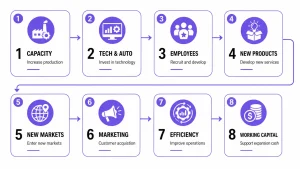
Investment can remove constraints that prevent an otherwise viable business from growing.
A company might have strong customer demand, for example, but lack sufficient production capacity to fulfil additional orders. Another business may have an effective product but insufficient capital to recruit sales staff or enter additional markets.
Investment provides the resources needed to close these gaps.
1. Increasing Production Capacity
One of the clearest uses of business investment is increasing the amount a company can produce or deliver.
A manufacturer might purchase additional machinery, while a logistics company could expand its vehicle fleet. A professional services business might invest in technology and additional employees to serve more clients.
Capacity investment can help a business:
- Process more orders
- Reduce production bottlenecks
- Serve additional customers
- Shorten delivery times
- Increase potential revenue
However, expanding capacity before sufficient demand exists can create unnecessary fixed costs. Businesses therefore normally need evidence that additional capacity is commercially justified.
2. Investing in Technology and Automation
Technology investment can support growth without requiring every increase in revenue to be matched by an equivalent increase in staffing or administrative costs.
Businesses may invest in customer relationship management software, accounting systems, automation tools, cybersecurity, cloud infrastructure, ecommerce platforms or specialist industry technology.
The potential benefits include greater productivity, fewer manual processes, improved customer service and better management information.
Technology can also improve scalability. A digital system capable of handling 10,000 customer transactions may allow a company to grow substantially before requiring another major increase in administrative resources.
The value of technology investment nevertheless depends on implementation. Software that employees cannot use effectively or that does not solve a genuine operational problem may add cost rather than productivity.
3. Recruiting and Developing Employees
Growth frequently requires people as well as physical assets.
Investment can allow companies to recruit employees with skills that are missing from the existing organisation. These might include engineers, salespeople, developers, managers, finance specialists or marketing professionals.
Companies can also invest in existing employees through training and professional development.
Recruitment can be particularly important when the founder or senior management team becomes a constraint on growth. Delegating specialist responsibilities can allow leadership to concentrate on strategy, partnerships, customers and long-term development.
Companies should nevertheless consider the full cost of recruitment, including salary, employer obligations, equipment, training and the time required for a new employee to become productive.
4. Developing New Products and Services
Businesses can use investment to expand beyond their existing products or services.
Funding might be directed towards research, product design, prototypes, testing, intellectual property, manufacturing preparation or commercial launches.
Successful product development can create additional revenue streams and reduce reliance on a single product or customer segment.
The commercial outcome is uncertain, however. New products may not attract the expected level of demand, making market research and staged investment particularly important.
Businesses can reduce risk by testing assumptions before committing substantial capital.
5. Entering New Markets
Investment can provide the resources required for geographic expansion or entry into new customer segments.
A UK company might open another regional location, build a national distribution operation or explore overseas markets.
Expansion can require spending on areas such as:
- Local employees
- Premises
- Distribution
- Marketing
- Professional advice
- Compliance
- Translation or localisation
- Market research
The UK Government provides a range of information through its finance and support for businesses service, where companies can investigate funding and support programmes relevant to their circumstances.
Market expansion should generally follow commercial evidence rather than ambition alone. Management needs to understand expected demand, customer acquisition costs, local competition and the capital required to reach sustainable operations.
6. Strengthening Marketing and Customer Acquisition
A company cannot necessarily grow simply because it has greater production capacity. It also needs sufficient customer demand.
Investment in marketing can help businesses reach new customers through search marketing, content, advertising, events, partnerships, public relations and direct sales.
Companies researching wider commercial strategies can also use independent business resources such as Pro Business Blog alongside primary regulatory and government sources when researching broader business topics.
Marketing investment works best when results can be measured.
Instead of treating marketing solely as expenditure, management can examine metrics such as customer acquisition cost, conversion rate, average order value, repeat purchases and customer lifetime value.
That allows future investment decisions to be based on evidence.
7. Improving Operational Efficiency
Investment does not always need to increase the physical size of a company.
Some of the most valuable investments reduce the cost or time required to perform existing activities.
For example, investment might improve:
| Investment | Possible Business Effect |
| Automated software | Less repetitive administration |
| Modern machinery | Greater production efficiency |
| Inventory systems | Better stock management |
| Employee training | Higher productivity and capability |
| Energy-efficient equipment | Lower operating costs |
| Data analytics | Better management decisions |
| Customer systems | Improved sales and service processes |
Efficiency improvements can strengthen margins and create additional resources that can subsequently be reinvested into growth.
8. Supporting Working Capital During Expansion
Growth can itself create cash-flow pressure.
A business may need to purchase materials, increase inventory or pay additional employees before customers have paid their invoices.
This means a company can be profitable while still experiencing short-term cash-flow difficulties. The British Business Bank highlights the importance of cash-flow forecasting because it can help businesses identify potential funding shortfalls before they become critical.
Sufficient working capital therefore matters when businesses expand.
Without it, rapid growth can create financial strain instead of financial strength.
What Types of Business Investment Are Available?

There is no single funding method that suits every company.
Common approaches include retained profits, debt finance and equity investment, while some businesses may also qualify for grants or government-supported programmes.
| Funding Method | Main Advantage | Main Consideration |
| Retained profits | No borrowing or ownership dilution | Reduces cash available elsewhere |
| Business loan | Owners usually retain equity | Interest and repayments apply |
| Equity investment | No conventional loan repayments | Existing owners give up some ownership |
| Grants | Usually no repayment | Eligibility can be restrictive |
| Asset finance | Helps fund equipment purchases | Ongoing finance costs |
| Overdraft or credit facility | Flexible short-term liquidity | Can be relatively expensive |
| Angel investment | Capital plus potential expertise | Ownership and influence may be shared |
| Venture capital | Can provide substantial growth capital | Usually requires strong growth potential |
UK companies researching external funding can also explore the British Business Bank Finance Finder, which provides information designed to help businesses investigate potential finance options and prepare for funding.
What Is the Difference Between Debt and Equity Investment?
Debt and equity finance have fundamentally different commercial structures.
Debt finance involves borrowing money that normally needs to be repaid with interest. Ownership usually remains with the existing shareholders, but scheduled repayments create an ongoing cash-flow obligation.
Equity finance involves investors providing capital in exchange for an ownership interest in the company. Traditional loan repayments are generally avoided, but existing shareholders usually experience dilution and investors may receive influence over important business decisions.
Equity funding can be used at different stages of a company’s development, including early-stage funding and later growth rounds.
The appropriate option depends on factors including profitability, cash flow, assets, growth potential, risk appetite and how much control existing owners are prepared to share.
How Can Investment Improve a Company’s Competitive Position?
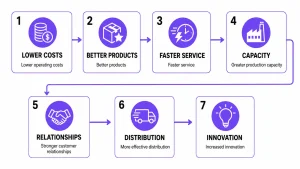
Well-targeted investment can create advantages that are difficult for competitors to reproduce quickly.
A company might invest in proprietary technology, specialist employees, intellectual property, customer experience or more efficient production systems.
These investments can produce advantages through:
- Lower operating costs
- Better products
- Faster service
- Greater production capacity
- Stronger customer relationships
- More effective distribution
- Increased innovation
Competitive advantage normally comes from how capital is deployed rather than simply how much is invested.
A smaller company using £100,000 effectively may create substantially more commercial value than a larger business spending £1 million without a clearly defined investment strategy.
What Is Return on Investment?
Return on investment, commonly called ROI, is one way of comparing the financial benefit of an investment with its cost.
A simplified calculation is:
ROI = (Gain from investment − Cost of investment) ÷ Cost of investment × 100
For example, if a company invests £50,000 and attributes £65,000 of net financial benefit to the project, the simplified gain above the investment cost would be £15,000.
The resulting ROI would be 30%.
This simplified calculation does not account for every financial consideration. Timing, financing costs, taxation, depreciation, risk and alternative uses of capital may materially affect a real investment decision.
Companies considering significant investments may therefore require detailed financial modelling and appropriate professional advice.
Can Business Investment Reduce Costs?

Yes. Growth investment does not have to focus exclusively on revenue.
A company can improve profitability by investing in systems that reduce operating expenditure.
For example, new equipment might require £100,000 of capital but reduce annual production costs considerably. If those savings continue for several years, the investment may generate value without directly increasing sales.
Cost-saving investments may include automation, energy efficiency, inventory optimisation, supply-chain improvements and process redesign.
For qualifying expenditure, UK businesses may also be able to use capital allowances to deduct some or all of certain capital costs when calculating taxable profits.
Eligibility and treatment depend on the asset, business circumstances and current tax rules, so the latest HMRC guidance or professional tax advice should be checked before relying on a particular tax outcome.
What Are the Risks of Investing in Business Growth?
Investment introduces risk because the expected commercial benefit may not materialise.
Common risks include overestimating demand, borrowing too heavily, expanding too quickly, underestimating project costs or investing in technology that becomes unsuitable.
Equity finance introduces different considerations, including shareholder dilution and potentially greater investor involvement in company decisions.
Businesses can reduce these risks through forecasting, market validation, staged spending and clear performance measurement.
One useful approach is to establish defined milestones before additional money is released.
For example, a company testing a new market might first invest in research and a small pilot. A larger rollout could then depend on whether the pilot achieves predetermined sales or customer acquisition targets.
Does More Investment Always Mean Faster Growth?

No.
Increasing investment without increasing the quality of business decisions can destroy rather than create value.
Capital needs to be deployed where the company has credible opportunities.
A business with weak customer demand will not necessarily become stronger by purchasing more equipment. Similarly, hiring additional employees will not automatically improve performance if responsibilities and commercial objectives are unclear.
The relationship between investment and growth therefore depends on capital efficiency — how effectively the company converts investment into sustainable economic value.
When Should a Business Seek External Investment?
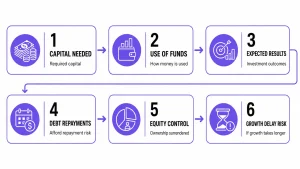
External funding may become appropriate when an attractive commercial opportunity requires more capital than the company can reasonably generate internally.
Typical situations include expansion into new markets, major equipment purchases, significant recruitment, acquisitions or rapid product development.
Before raising money, the business should understand:
- How much capital is genuinely required.
- Exactly how the money will be used.
- What results the investment is expected to produce.
- Whether the company can afford repayments if debt is used.
- How much ownership or control may be surrendered if equity is used.
- What happens if growth takes longer than expected.
These questions can make the distinction between strategic investment and simply raising money because finance is available.
Final Thoughts
Business investment can help companies grow and expand when capital is directed towards clear commercial opportunities.
Investment can increase productive capacity, improve technology, support recruitment, fund new products, strengthen marketing, reduce operating costs and allow companies to enter new markets. It can also provide the working capital necessary to support expansion.
However, access to finance should not be confused with successful investment.
Strong investment decisions require realistic forecasts, clear objectives, appropriate funding structures and disciplined performance measurement. Companies that understand both the potential return and the downside risk are better positioned to use investment as a sustainable driver of long-term growth.
For UK businesses, government programmes, commercial finance, retained profits and equity investment can all form part of a wider funding strategy. The appropriate combination will depend on the individual company’s financial position, growth stage and objectives
Frequently Asked Questions
How does investment contribute to business growth?
Investment contributes to growth by giving companies resources to increase capacity, recruit employees, develop products, improve technology, attract customers and enter new markets. The effect depends on whether those resources ultimately generate sufficient additional economic value.
Can small businesses benefit from investment?
Yes. Investment can be particularly important for smaller businesses because limited internal resources may otherwise restrict expansion. However, the amount and type of funding should remain proportionate to the company’s financial capacity and commercial opportunity.
Can investment improve profitability?
Investment can improve profitability when it increases revenue, reduces costs or improves productivity by more than its overall cost. There is no guarantee that an investment will generate the expected return.
Is taking a business loan considered investment?
A business loan is a source of finance rather than the investment itself. The borrowed capital can subsequently be invested in equipment, employees, technology, inventory, marketing or other business activities. Loans normally involve interest and repayment obligations.
What is the best form of investment for a growing business?
There is no universally best funding structure. Retained earnings, loans, equity finance, grants and asset finance each have different advantages and risks. The right structure depends on the company’s cash flow, objectives, stage of development and willingness to take on debt or dilute ownership.
Why is cash flow important when investing?
Investment often requires money to be spent before the financial benefit appears. A business therefore needs sufficient liquidity to continue paying employees, suppliers, tax liabilities and other operating expenses during the growth period.