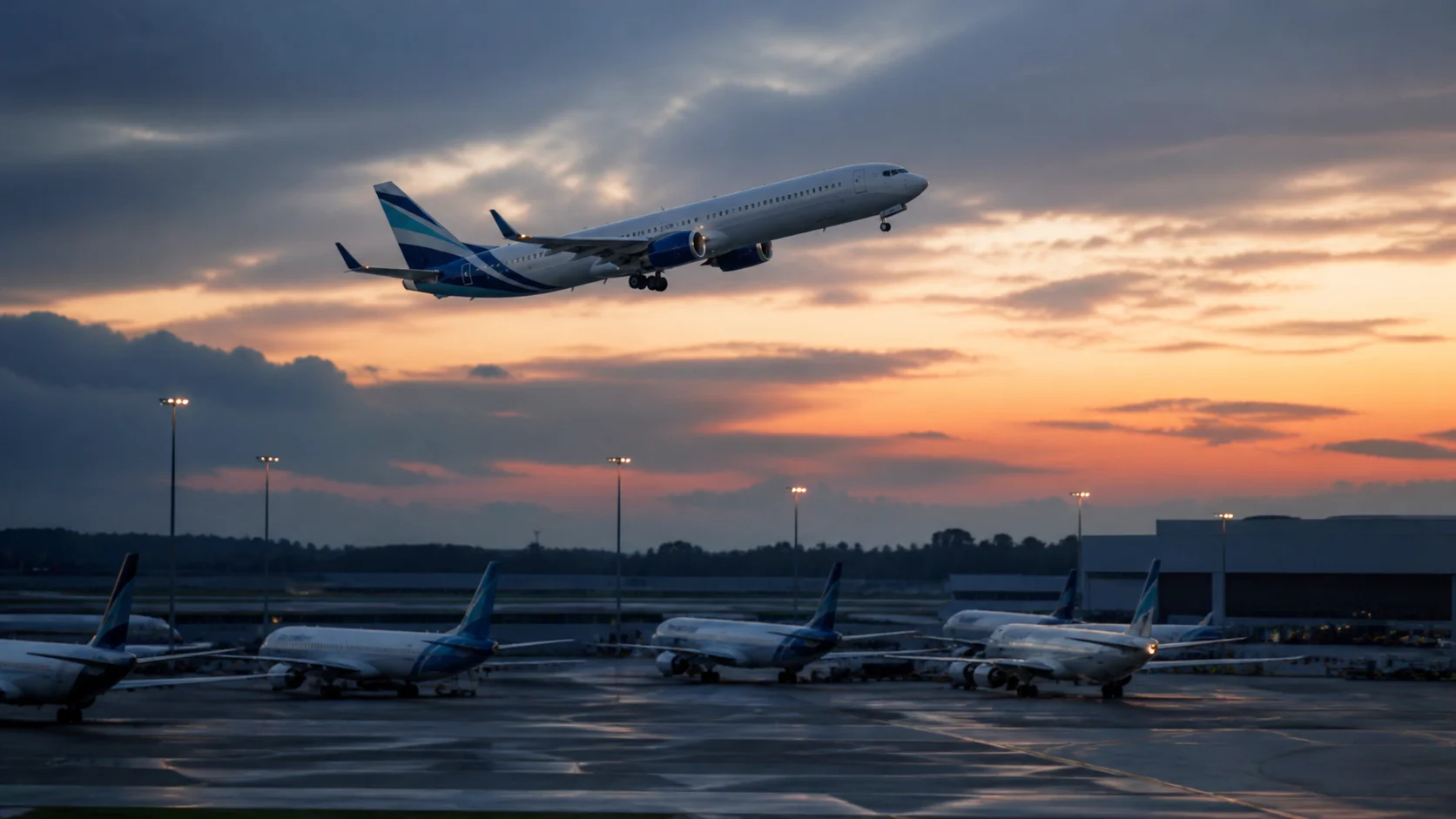

The Ascend Airways liquidation has sent shockwaves through the UK aviation sector, with the airline cancelling all flights immediately and ceasing operations.
The wet-lease carrier, which operated from major hubs like Gatwick and Stansted, collapsed under mounting financial pressures, rising fuel costs, and an inability to secure contracts.
Its shutdown not only disrupted partner airlines but also left employees and industry stakeholders facing uncertainty.
Key highlights:
- Ascend Airways entered liquidation and halted all operations instantly
- Flights were cancelled following the final Oman Air service landing at Stansted
- Rising fuel costs and economic pressures were major causes
- The airline surrendered its UK Air Operator’s Certificate (AOC)
- Around 161 jobs have been affected
This article explores the causes, impact, and broader implications of the Ascend Airways collapse.
What Happened in the Ascend Airways Liquidation Case?
The Ascend Airways liquidation unfolded rapidly, with the airline confirming that all flights were cancelled with immediate effect.
The decision followed internal communications to staff, informing them that operations would cease after the final flight from Muscat, operated in partnership with Oman Air, landed at Stansted Airport.
The airline, which had been operating out of Gatwick and Stansted, officially grounded its fleet and began the process of returning aircraft.
Crucially, Ascend Airways also surrendered its UK Air Operator’s Certificate (AOC), effectively removing its legal ability to operate commercial flights in the UK.
Timeline of Key Events
- Internal communication to staff announcing liquidation
- Final Oman Air flight lands at Stansted (April 30)
- Immediate cancellation of all flights
- The fleet grounded and returned
- AOC surrendered
This sequence of events highlights how quickly airline operations can collapse once financial viability is lost.
What Is Ascend Airways, and How Did It Operate as a Wet-Lease Airline?
Ascend Airways was not a typical passenger airline. Instead, it operated as a wet-lease (ACMI) provider, supplying aircraft, crew, maintenance, and insurance to other airlines. Originally founded in 2004 as Synergy Aviation, the company rebranded as Ascend Airways in 2023.
Its business model relied heavily on contracts with larger carriers such as Oman Air, Air Sierra Leone, and TUI Airways.
At the time of collapse, the airline operated a modest fleet, including Boeing 737-800 and Boeing 737 MAX 8 aircraft.
Understanding the Wet-Lease Model:
- Airlines lease fully operational aircraft with crew
- Short-term contracts to meet demand spikes
- Lower brand visibility but high operational dependency
- Revenue tied directly to contract availability
Aviation analyst Mark Davies notes:
“Wet-lease carriers like Ascend Airways operate on thin margins and high dependency on contracts. When those contracts dry up, the business model becomes extremely fragile.”
This operational structure made Ascend Airways particularly vulnerable to market fluctuations.
Why Did Ascend Airways Go Into Liquidation?

The collapse of Ascend Airways was not due to a single issue but a mix of internal weaknesses and external pressures.
Like many smaller UK carriers, it faced rising costs while struggling to maintain consistent contract revenue. Over time, these challenges became unsustainable, leading to liquidation.
Economic Pressures and Rising Operational Costs
A key factor was the sharp rise in jet fuel prices. Geopolitical tensions, particularly involving Iran, disrupted supply chains and pushed costs higher. For an airline operating on tight margins, this created immediate financial strain.
The UK aviation market also proved costly. Higher taxes, airport fees, and regulatory expenses compared to Europe reduced competitiveness.
This made it difficult for Ascend Airways to price services competitively while staying profitable.
An aviation economist noted:
“The UK aviation market is among the most expensive in Europe, and smaller operators cannot absorb prolonged cost increases without strong contracts.”
These pressures weakened the airline’s financial stability, leaving little room for recovery.
Contract Challenges and Strategic Limitations
Ascend Airways also struggled to secure enough wet-lease contracts, which were central to its ACMI model. As agreements became inconsistent, revenue declined significantly.
Strategic setbacks worsened the situation. The airline failed to obtain IOSA certification, limiting expansion into new markets. Efforts to secure rescue investment also fell through, removing potential financial support.
Key factors included:
- Rising jet fuel prices
- High UK operating costs
- Weak wet-lease contract pipeline
- Failed IOSA certification
- Economic instability
Ultimately, these combined challenges made continued operations impossible, leaving liquidation as the only option.
How Did the Collapse Impact Employees and Jobs?
The collapse of Ascend Airways has had a significant human impact, with around 161 employees affected by the sudden shutdown.
Staff were informed that operations would cease immediately, leaving little time to prepare for financial or career consequences. The abrupt nature of the closure has added to uncertainty about their next steps.
Reports indicate some employees may not receive full wages, as payments are now subject to the liquidation process. Many are expected to rely on government-backed compensation schemes, which may not cover the full amount owed.
Alongside financial concerns, the situation has also caused emotional stress, particularly for long-serving staff.
Employee Experiences and Immediate Impact
The sudden closure has left employees facing both financial instability and career disruption. Aviation roles are highly specialised, making it difficult to secure new opportunities quickly, especially during uncertain market conditions.
A former cabin crew member shared:
“We were expecting challenges, but not this sudden collapse. We’ve been told we might not receive full pay for May, and everything now depends on the liquidators.”
This reflects the uncertainty many employees are experiencing as they adjust to the airline’s closure.
Key Challenges Faced by Employees
- Job losses and sudden career disruption
- Uncertainty over unpaid wages and final settlements
- Reliance on statutory compensation schemes
- Emotional and financial stress during transition
These challenges highlight the vulnerability of aviation employment, where economic pressures can quickly lead to workforce instability.
How Does Ascend Airways Liquidation Affect Passengers?
Although Ascend Airways primarily operated as a wet-lease provider, its collapse still had ripple effects on passengers booked through partner airlines. Flight cancellations created immediate disruption, particularly for those travelling via Gatwick and Stansted.
Passengers are typically protected under UK aviation laws, depending on how tickets were purchased and the nature of the booking.
Traveller Experience and Disruption
For many passengers, the immediate impact was uncertainty and inconvenience. Flights were cancelled at short notice, leaving travellers to depend on partner airlines for alternative arrangements. In some cases, this resulted in delays, route changes, or unexpected expenses.
Real-time example (Traveller perspective):
During research, I came across a frequent traveller who had previously flown on an Ascend-operated aircraft via a partner airline. They explained:
“You don’t always realise which airline is operating your flight. When cancellations happen like this, it creates confusion about who is responsible.”
This perspective illustrates how wet-lease operations can complicate the passenger experience during airline disruptions.
Passenger Rights and Recommended Actions
Passengers affected by such disruptions should take the following steps to minimise inconvenience and financial loss:
- Check the booking provider (airline or travel agent) to confirm who is responsible
- Apply for refunds or request rebooking through the issuing airline
- Use travel insurance to claim additional costs where applicable
- Contact the Civil Aviation Authority (CAA) for official guidance
Taking these actions can help passengers better manage the impact of sudden airline failures and ensure they receive the support they are entitled to.
What Happens When a UK Airline Enters Liquidation?
When an airline enters liquidation, it ceases operations and begins the process of settling debts. Assets such as aircraft are returned or sold, and the company’s licences, including the AOC, are surrendered.
This process prioritises creditors, often leaving employees and smaller stakeholders with limited recovery.
Airline Liquidation Process Overview:
| Stage | Description |
| Cease Operations | Immediate halt of all flights |
| Appoint Liquidators | External professionals manage assets |
| Asset Distribution | Aircraft and assets returned or sold |
| Creditor Payments | Funds distributed based on priority |
| Company Dissolution | Legal closure of the business |
This structured process ensures legal compliance but rarely benefits all affected parties equally.
Why Is the Jet Fuel Crisis Affecting UK Airlines So Severely?

The global jet fuel crisis has been a major factor behind the Ascend Airways liquidation. Prices have surged dramatically, placing immense pressure on airlines already operating with tight margins.
Geopolitical tensions, particularly involving Iran, have disrupted supply chains and driven costs higher. UK airlines are especially vulnerable due to higher taxes and operational expenses compared to their European counterparts.
Industry expert József Váradi has warned:
“Airlines go bust in cycles, and rising fuel prices combined with seasonal demand fluctuations create a perfect storm for weaker carriers.”
This environment has led to increased concerns about further airline collapses in the near future.
What Is Happening to Ascend Airways Malaysia Operations?
Interestingly, while the UK arm of Ascend Airways has collapsed, its Malaysian division remains operational. The company has confirmed that this branch continues to meet its contractual obligations and is progressing with expansion plans.
UK vs Malaysia Operations Comparison:
| Aspect | UK Operations | Malaysia Operations |
| Status | Liquidated | Active |
| AOC | Surrendered | Valid |
| Services | Passenger wet-lease | Cargo (expanding to passenger) |
| Fleet | Returned | Boeing 737-800 freighter |
| Future Plans | None | Passenger services launch planned |
This distinction highlights how different market conditions can impact separate divisions of the same company.
Could the Ascend Airways Collapse Have Been Prevented?
While hindsight offers clarity, several warning signs were evident prior to the collapse. Financial difficulties, unpaid bills, and reliance on securing key certifications all pointed to underlying instability.
The airline’s dependence on external contracts meant that any disruption in demand could quickly escalate into a crisis. Additionally, high operating costs in the UK reduced its competitive edge.
Strategically, diversification and stronger financial buffers may have delayed or mitigated the collapse. However, external factors such as fuel costs and geopolitical tensions were largely beyond the airline’s control.
What Should Travellers and Industry Stakeholders Learn from This Collapse?
The Ascend Airways liquidation offers valuable lessons for both passengers and aviation businesses. For travellers, it highlights the importance of understanding booking structures and securing travel insurance. For airlines, it underscores the need for resilience in an increasingly volatile market.
Businesses must adapt to rising costs, fluctuating demand, and global uncertainties. Meanwhile, passengers should remain informed and prepared for potential disruptions.
Ultimately, the collapse serves as a reminder that even established operators are not immune to financial pressures.
Ascend Airways Liquidation at a Glance
| Key Factor | Details |
| Airline Name | Ascend Airways |
| Founded | 2004 (Synergy Aviation) |
| Rebrand | 2023 |
| Type | Wet-lease (ACMI) |
| Airports | Gatwick, Stansted |
| Fleet | Boeing 737-800, 737 MAX 8 |
| Jobs Affected | ~161 |
| Key Causes | Fuel costs, economic pressure |
| Malaysia Arm | Operational |
This summary provides a quick snapshot of the airline’s rise and fall.
Conclusion
The Ascend Airways liquidation reflects the growing challenges within the UK aviation industry. From rising fuel costs to economic pressures and operational constraints, the factors behind the collapse are complex yet increasingly common.
While the airline’s Malaysian operations remain stable, the UK shutdown highlights vulnerabilities that could affect other carriers. For passengers, employees, and industry stakeholders, the event serves as both a warning and a learning opportunity.
As the aviation landscape continues to evolve, resilience, adaptability, and strategic planning will be essential for survival.
FAQs
What does airline liquidation mean?
Airline liquidation means the company ceases operations permanently and sells its assets to repay creditors.
Can passengers get refunds after an airline collapse?
Refunds depend on how tickets were purchased. Travel insurance and credit card protections may help recover costs.
What is a wet-lease airline?
A wet-lease airline provides aircraft, crew, maintenance, and insurance to other airlines on a contract basis.
Why are fuel prices impacting airlines so heavily?
Fuel is one of the largest operational costs, and price increases directly reduce profitability.
What is an Air Operator’s Certificate (AOC)?
An AOC is a legal licence required for airlines to operate commercial flights.
Are more UK airlines at risk of collapse?
Industry experts warn that rising costs could put additional pressure on financially weaker carriers.
How can travellers protect themselves when booking flights?
Using travel insurance and booking with reputable airlines can reduce financial risk.